BAE Systems (BA.L) Stock Analysis: Bullish Trend, Defence Premium & Geopolitical Outlook 2026
$2227p
02 Mar 2026, 17:30
Bullish


Join Minipip Academy and access free courses in investing, trading, economics, and more.
Sign Up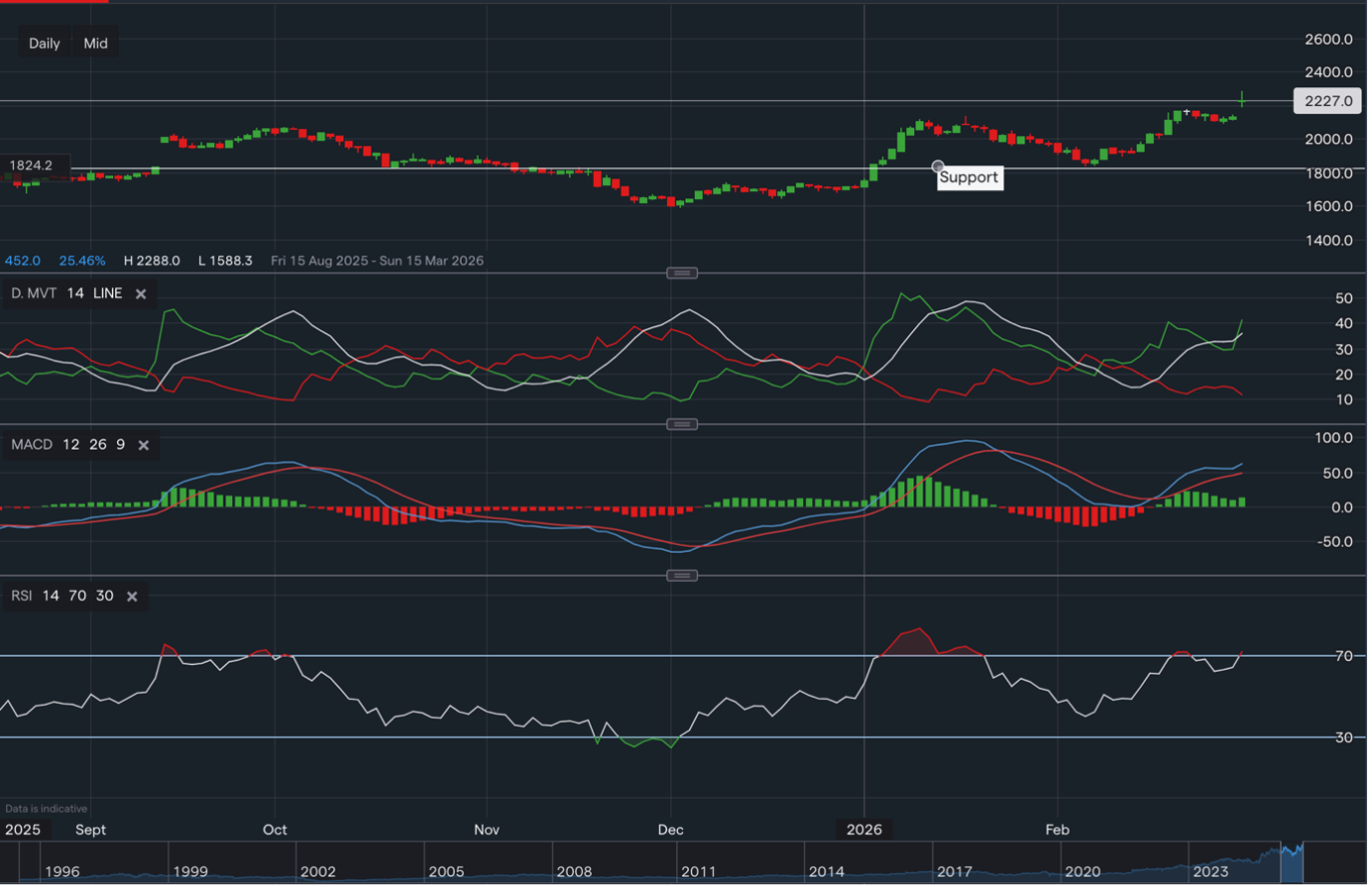
BAE Systems (BA.L) Stock Analysis: Bullish Trend, Defence Premium & Geopolitical Outlook 2026


BAE Systems is one of Europe’s largest defence contractors, with significant exposure to the UK Ministry of Defence, US Department of Defence, NATO partners, and Middle Eastern clients. Revenue is heavily supported by long-term government contracts, creating relatively predictable cash flow compared to cyclical commercial aerospace firms.
The current macro backdrop – elevated geopolitical tensions (Ukraine conflict, Middle East escalation, NATO re-armament, cybersecurity threats) – structurally supports defence spending. This has been a key driver behind the recent breakout and sustained uptrend.
Fundamentals
BAE Systems currently trades with a market capitalisation of approximately £65.33B, reflecting elevated investor demand amid sustained geopolitical instability and expanding defence budgets.
The stock is valued at a trailing P/E of 31.1, which compresses to a forward P/E of 25.6, indicating that the market is pricing in meaningful earnings growth over the next 12 months. Taking the Minipip’s average multiple approach, the Average P/E (28.35) provides a midpoint valuation reference between current and forward expectations.
The discrepancy between the 26% projected earnings increase and the 9-11% EPS growth likely reflects share count stability, conservative analyst guidance, or rounding differences in consensus data.
Using the Minipip framework (Average P/E × Projected Earnings) we can see an implied market value of roughly £72.34B.
Compared to the current £65.33B market capitalisation, this suggests a 10-11% theoretical upside under this assumption.
Analyst Consensus & Market Expectations
Of 19 analysts, the majority recommend Buy (8) or suggest outperformance bias (3).
The average target is 22.67 while the current price sits 22.27.
Price is very close to consensus average target, meaning the stock is currently fairly valued relative to analyst expectations.
The upside to the high target (26.00) remains, but this assumes continued defence budget acceleration.
Price Action & Technical Analysis
Trend Structure (EMA Alignment) confirms a strong multi-timeframe bullish structure:
RSI currently reads 72.47, placing the stock in technically overbought territory. It is important to note that overbought conditions in established trends do not automatically imply reversal; rather, they often reflect strength. In sustained bullish phases, RSI can remain in the 70-80 range for extended periods while price continues to advance. The Chaikin Money Flow (CMF) reading of 0.1 confirms positive capital inflow, suggesting that buying pressure remains supportive rather than purely speculative.
Momentum indicators continue to support the prevailing bullish structure. The MACD remains positive and above the signal line, with histogram strength indicating sustained upward momentum.
A +DI of 38.8 and -DI of 14.17 show that buyers are clearly dominant. An ADX of 26.08 further confirms this trend strength, while a share price of 2227 is near enough to VWAP 2239 to suggest enough institutional and retail volume to power it.
Current volatility conditions indicate expansion rather than contraction. The Average True Range sits at 63.88, reflecting elevated daily movement relative to prior periods. Bollinger Band Width at 22.57% is expanding and moving away from earlier compression levels, signalling a volatility expansion phase.
From a structural perspective, the chart remains constructive. Historical support is visible in the 1800-1830 region, which previously acted as resistance during earlier consolidation. More recently, emerging support is developing around the 2110 level, reflecting the market’s re-pricing following the latest breakout.
Conclusion
BAE Systems remains structurally bullish, supported by aligned moving averages, strong directional momentum, expanding volatility, and sustained capital inflows following a geopolitically driven breakout that has transitioned into continuation.
Fundamentally, BAE Systems does not appear deeply undervalued, with much of the current defence premium already reflected in its valuation; therefore, further upside is contingent upon forward earnings delivery and sustained geopolitical support for defence spending. The UK’s decision to permit expanded US defence positioning from its military bases suggests a continued combat-ready posture, reinforcing the probability of elevated procurement and contract flow that could underpin market performance.
Key risks include further US and Israeli escalation involving Iran, prolonged conflict in Ukraine, and persistent cybersecurity threats from Russia, all of which could sustain defence demand and support the uptrend. Conversely, a rapid and comprehensive de-escalation of major conflicts, while currently unlikely, would materially weaken the macro tailwind and could invalidate the bullish thesis through multiple compression and reduced immediate cash flow or future contracts.
Disclaimer
This content is for educational and informational purposes only and should not be considered financial advice. Always conduct independent research or consult a qualified financial professional before making investment decisions.

Tradable assets:
Min.Deposit:
Max Leverage:
FCA:

Rating:


 Earnings Calendar
  Economic Calendar
  VAT Calculator
  Tax Free Childcare Calculator
 Percentage Calculator
 Compound Interest Calculator
  Loan Overpayment Calculator
 Mortgage Calculator
 Credit Card Calculator
 Investing
  Economics
 Trading
  Technical Analysis
  Personal Finance
 Calculator