AbbVie (ABBV) Stock Analysis: Humira Decline, New Drug Growth, and Technical Consolidation
$228.47
06 Mar 2026, 17:58
Neutral


Join Minipip Academy and access free courses in investing, trading, economics, and more.
Sign Up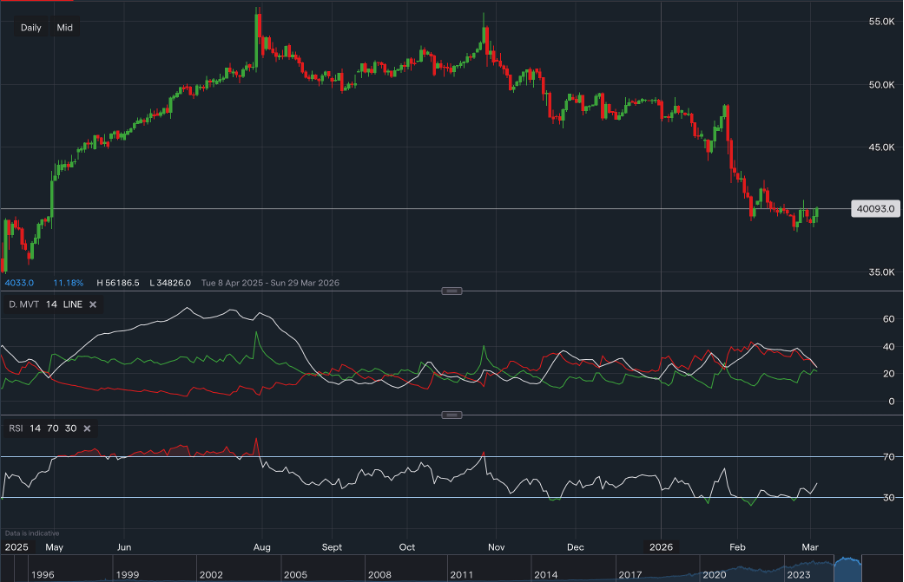
Microsoft (MSFT) Stock Analysis 2026:


Overview
Microsoft (MSFT), traded on the Nasdaq, is currently priced at $400.94, maintaining its position as one of the largest publicly listed companies globally. With daily volume at 8.87 million shares, a free float of 7.31 billion, and 7.43 billion shares outstanding, liquidity remains deep and institutional participation strong. The company commands a current market capitalisation of $2.94 trillion, supported by trailing earnings of $119.26 billion. On valuation, Microsoft trades at a trailing P/E of 24.74 and a forward P/E of 20.80, giving an average multiple of 22.77. Based on projected earnings of $141.17 billion, this implies a forward market capitalisation of approximately $3.21 trillion: a potential upside of +9.47% relative to current levels. Earnings per share stand at $15.98 (TTM), with projected EPS of $19.01, reflecting an anticipated growth rate of 18.96%, reinforcing the company’s continued earnings expansion narrative.
Analyst Consensus & Market Expectations
From a fundamental perspective, analyst sentiment toward Microsoft remains extremely constructive. The stock currently carries 36 Strong Buy ratings, with 33 Buy, 3 Hold, and no Sell recommendations, reflecting broad institutional confidence in its earnings trajectory and AI-led growth strategy. Price targets range from a low of $392 to a high of $678, with an average target of $594.02, implying approximately 48.13% upside from current levels. This dispersion suggests that while downside risk is perceived as relatively contained near current pricing, substantial upside remains embedded in long-term expectations.
However, risks are not negligible. Microsoft’s aggressive expansion into AI requires significant capital expenditure for data centres and infrastructure, which may pressure margins if revenue scaling falls behind capital investment flow. Additionally, regulatory scrutiny from the FTC and other global authorities presents structural headline risk, particularly as Microsoft deepens its strategic reliance on OpenAI, which has attracted recent headlines for revising its U.S. Department of Defence agreement following political backlash over contract timing and surveillance safeguards. Policy changes following the breakout of the Iran war may encourage traders to investigate OpenAI’s trajectory.
The thesis would face invalidation if earnings momentum fails to materialise while capital intensity remains elevated, especially considering the stock is currently trading near $399.86 (3 March 2026, 11:45 AM EST), well below its October 2025 peak near $559, signalling that the market has already repriced according to risk perceptions within the global market.
Price Action & Technical Analysis
Current price is hovering near its intraday VWAP of $398, but the broader technical structure remains bearish. Price is positioned below all major Ichimoku levels (Conversion 394.60, Base 432.73, Lead A 413.66, Lead B 425.71), confirming a negative regime, while the EMA stack remains decisively bearish with 20 < 50 < 200 (407.05 < 433.25 < 463.58). Directional indicators reinforce this view, with -DI (33.67) above +DI (23.02) and ADX at 32.3, signalling a strong, active downtrend rather than a ranging environment. Volatility, measured by ATR at 10.85, has cooled from its April 2025 high but remains elevated relative to historical lows, while Bollinger Band width at 7.68% suggests compression that could precede expansion. Momentum indicators, however, show short-term counter-trend strength: MACD remains negative but is above its signal line with a positive histogram, RSI has risen to 41.86, and CMF at 0.09 indicates mild accumulation in volume. Overall, the structure points to a temporary daily relief rally within a stable medium-term downtrend and a still-intact long-term bearish monthly trend, leaving the broader bias tilted to the downside unless price reclaims key moving averages and cloud levels.
Catalysts
Key near-term catalysts for Microsoft Corporation centre on cloud acceleration, AI monetisation, and infrastructure optimisation. Azure remains the primary earnings driver, with Azure and related cloud services growing 39% year-on-year in Q2 FY2026, signalling renewed enterprise demand and AI workload expansion in line with the current trend in operational changes across sectors. At the application layer, Microsoft 365 Copilot has reached 15 million paid enterprise seats, up more than 160% year-on-year, suggesting the product is approaching a commercial tipping point where AI integration moves from an experiment to a fully embedded system within corporate IT.
Meanwhile, Microsoft’s custom silicon roadmap, including the rollout of Maia 200 AI accelerators and Cobalt CPUs, is strategically important for margin expansion, as it reduces dependence on third-party hardware providers and lowers inference costs across Azure, i.e. the cost every time someone uses the model (an ongoing operational expense).
A secondary knock-on effect may emerge in the broader cobalt supply chain, where shifting production dynamics away from the Democratic Republic of Congo have already tightened supply and increased reliance on recycled and alternative sources; a development that could influence component pricing and cloud infrastructure economics over time. The synergistic relationship between MSFT and cobalt may be a signal for traders and investors to watch both the technology and commodities markets in tandem.
Conclusion
Microsoft Corporation remains a structurally high-quality enterprise with strong earnings visibility, dominant cloud positioning, and accelerating AI monetisation through Azure and Copilot. Fundamentally, projected earnings growth near 19% and consensus upside potential above current levels support the longer-term investment case.
However, technically the stock remains in a confirmed downtrend across medium- and long-term timeframes, with current price action reflecting a short-term relief rally rather than a confirmed reversal. Capital intensity tied to AI infrastructure, regulatory scrutiny, and sensitivity to government AI contracts increases the risk of impacting valuation multiples negatively if sentiment weakens further.
In summary, Microsoft presents a long-term growth strategy with near-term technical fragility; it is attractive fundamentally, but requires technical confirmation before a sustained bullish continuation can be validated.
In one line: for investors first, traders second.
Disclaimer
This content is for educational and informational purposes only and should not be considered financial advice. Always conduct independent research or consult a qualified financial professional before making investment decisions.

Tradable assets:
Min.Deposit:
Max Leverage:
FCA:

Rating:


 Earnings Calendar
  Economic Calendar
  VAT Calculator
  Tax Free Childcare Calculator
 Percentage Calculator
 Compound Interest Calculator
  Loan Overpayment Calculator
 Mortgage Calculator
 Credit Card Calculator
 Investing
  Economics
 Trading
  Technical Analysis
  Personal Finance
 Calculator